
INSIZE Laser Projection System Recommended Solution — Railway & Locomotive
16-10-2026
Main Advantages
Rail Transit: In the manufacture of large transport vehicles such as trains, high-speed rail and metros, the capabilities of laser projection equipment are fully exploited, and the multi-unit simultaneous projection function can effectively increase the efficiency of lay-up and drilling/layout marking.
For rail transit applications, the INSIZE DLP-L Series Laser Projection Systems project CAD-based positioning outlines onto workpiece surfaces to guide assembly, welding, drilling, and painting operations. The series supports partial projection and hole-free positioning, and can automatically record operations and generate digital documents and databases. The DLP-L100 uses a laser scanning sensor, while the DLP-L600 combines a high-precision binocular vision system with a laser scanning sensor and supports dynamic tracking.
Case Study: Rail Transit and Shipbuilding
When cutting, marking out and labeling on train surfaces, the required pattern can be projected onto the body or steel-frame surface with laser projection for assistance — saving the time otherwise spent locating reference points from drawings and measuring with a ruler, and effectively increasing work efficiency.
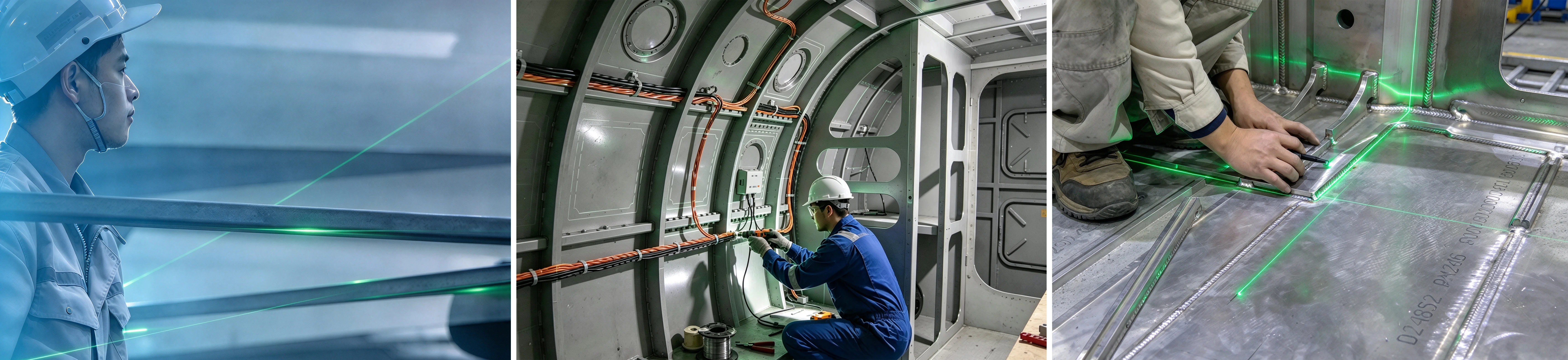
Projection onto curved inner walls follows the same principle; annotation and other functions can assist with wiring and inspection, and the laser can also aid hole drilling and paint layout marking.
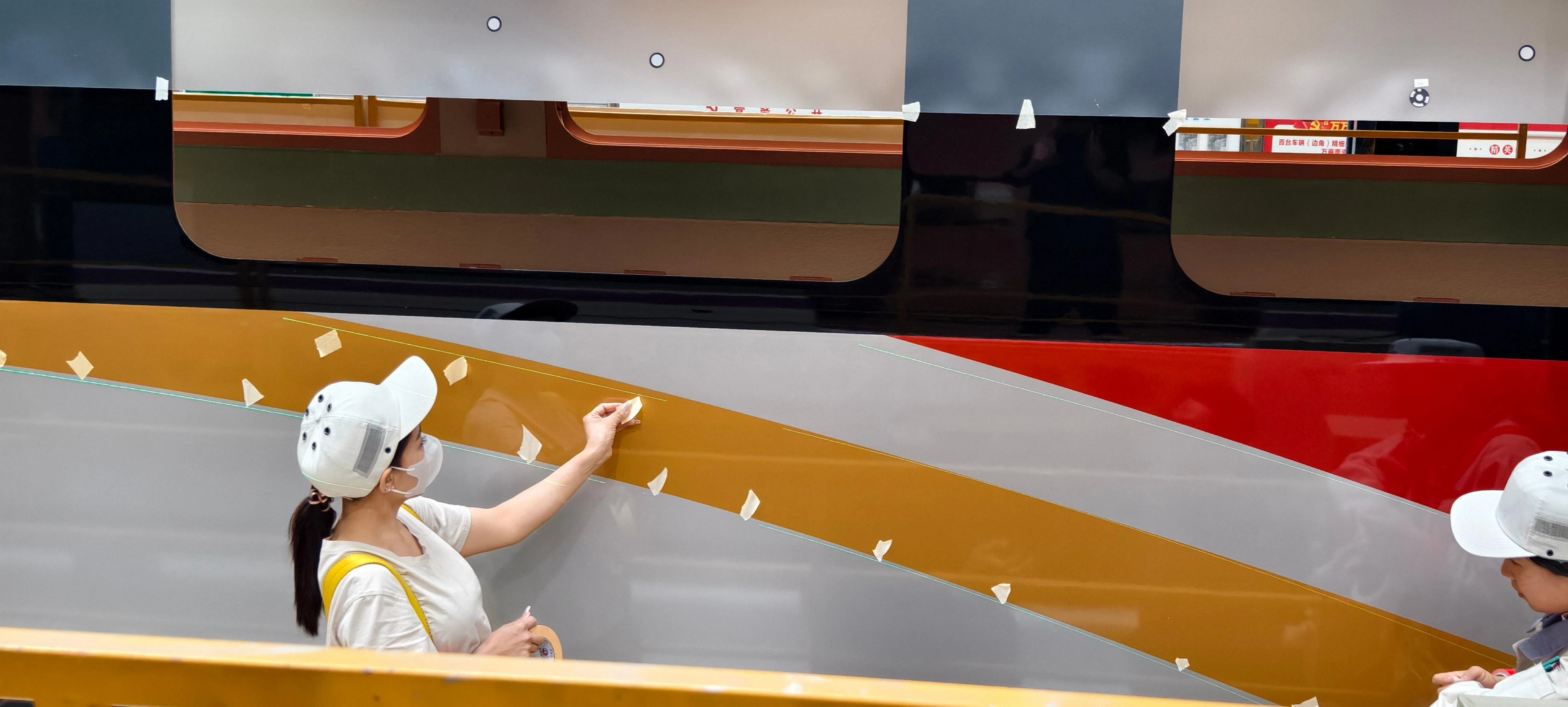
Following the same principle as composite materials and aircraft painting, train-surface painting can also use the laser projection system for assisted positioning and guidance. The difference is that positioning references on trains are relatively harder to find, so even more manual searching and positioning time can be saved.
Farewell to Physical Templates: How 3D Laser Projection Empowers Rail Transit and High-Speed Train Manufacturing
1. Digital Chassis and Frame Welding: Eliminating Overhead Crane Operations
During the welding of chassis and frames for high-speed trains and metro vehicles, precise positioning of a large number of components is critical. Using the Laser Projection system, digital CAD models can be projected directly onto the surface of the vehicle structure at a 1:1 scale with high accuracy. Workers simply position parts according to the laser outlines and tack-weld them in place before proceeding with final welding. This innovation completely eliminates the need for bulky steel templates and entirely removes the overhead crane operations previously required for template handling and changeovers.
2. Interior Installation and Wiring Accelerated by 70%
The routing of pipelines and the installation of interior components within railcar cabins are extremely complex. Guided by laser projections, operators can intuitively see every installation point, equipment bracket, and cable routing path. This intuitive "what you see is what you get" visual guidance mode significantly accelerates the interior installation process, boosting efficiency by up to 70%. Visual guidance simplifies complex tasks and greatly enhances both the flexibility and accuracy of the production line.
Bogie Frame Welding Positioning
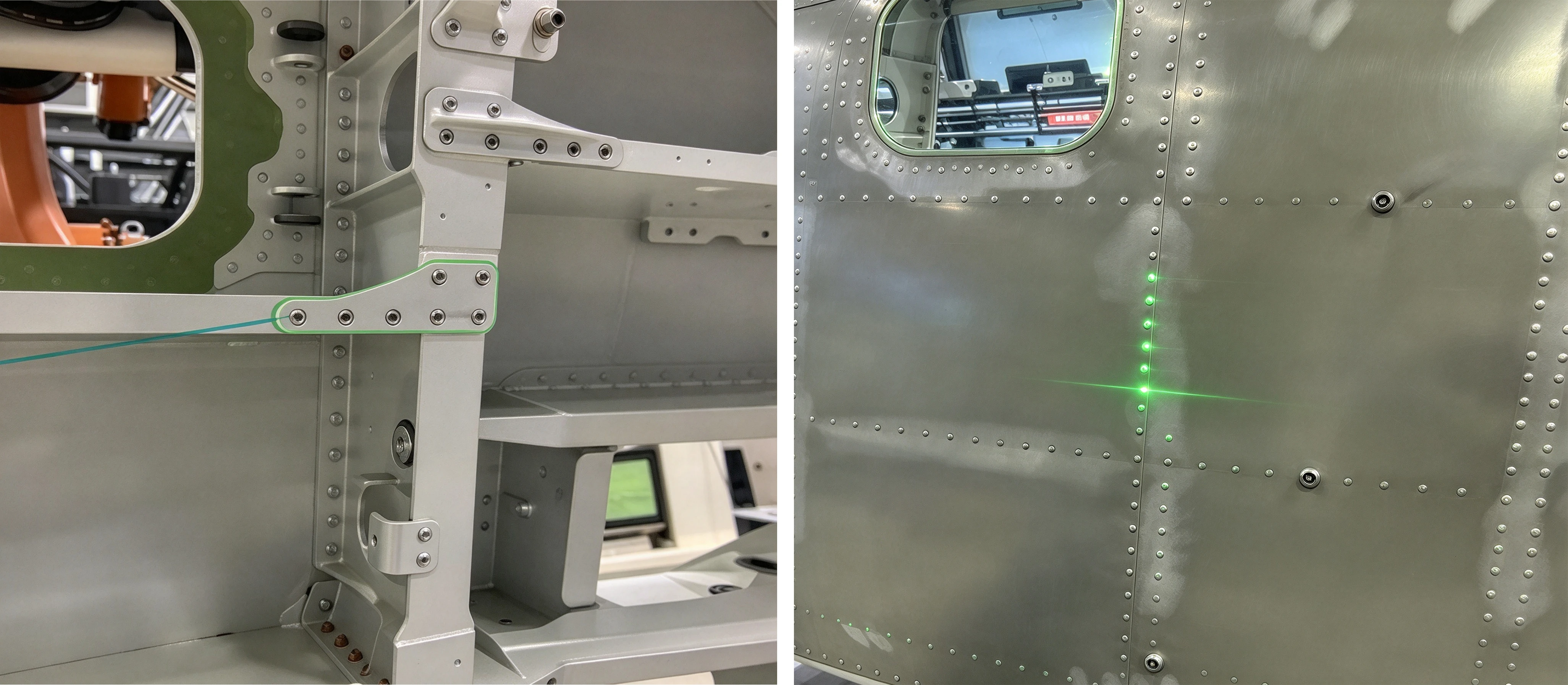
The bogie frame is the core running component that directly bears the car body weight and transmits traction and braking forces. It features a complex structure with dense weld seams and extremely high requirements for positioning accuracy. The specific positioning locations assisted by laser projection include:
Main Structure Assembly Welding Positioning: Assembly boundary lines and overlap contour lines for side members and cross members, ensuring that the alignment accuracy during main beam assembly is controlled within ±0.2 mm.
Key Component Installation Positioning: Installation hole positions and outer profiles for gear box mounting seats, primary/secondary suspension mounting seats, brake disc brackets, motor hanging seats, and traction link seats. All component installation positions are projected directly onto the frame surface, allowing workers to place components according to the laser outlines without manual measurement or alignment.
Weld Seam Trajectory Guidance: Side member V-groove full-penetration weld lines, fillet weld contours, and the paths of all load-bearing weld seams are projected in the form of laser lines. Workers can clearly see the start and end positions and direction of each weld segment, preventing missed or misplaced welds.
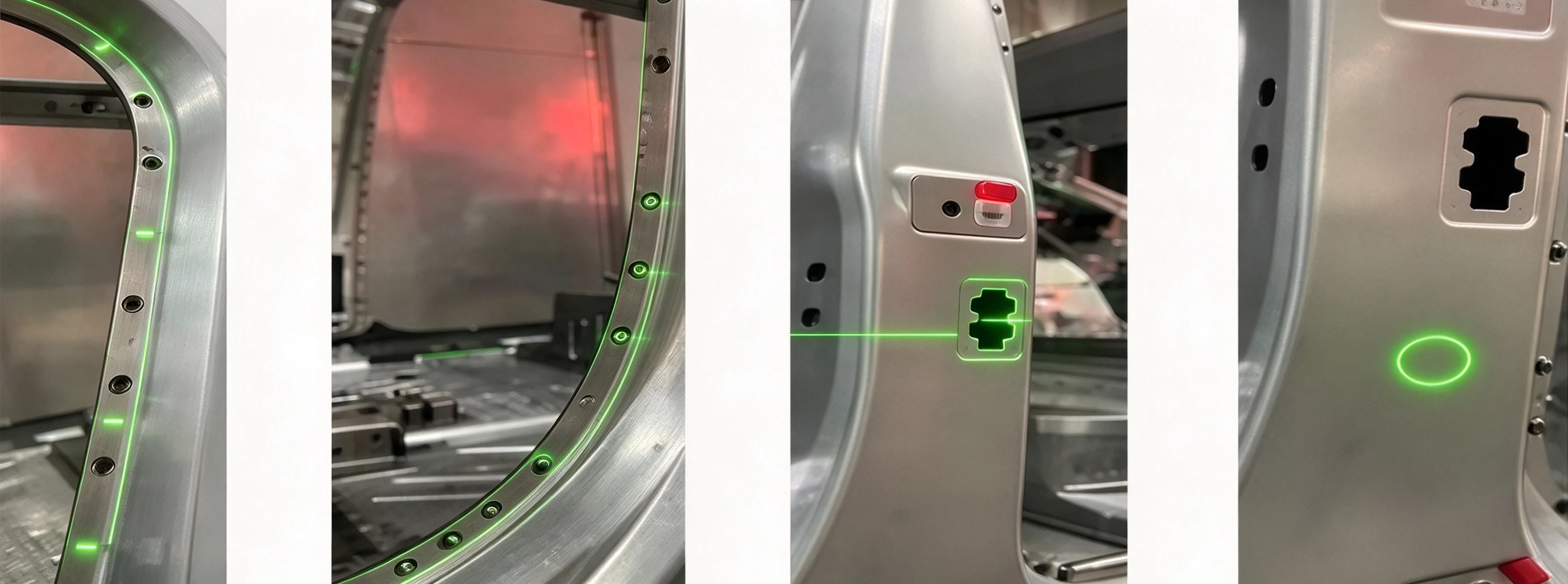
Bolt Pre-tightening Zone Identification: Pre-tightening force zones for critical connection bolts are directly marked, working in conjunction with torque-controlled tools to automatically adjust tightening force and ensure connection reliability.
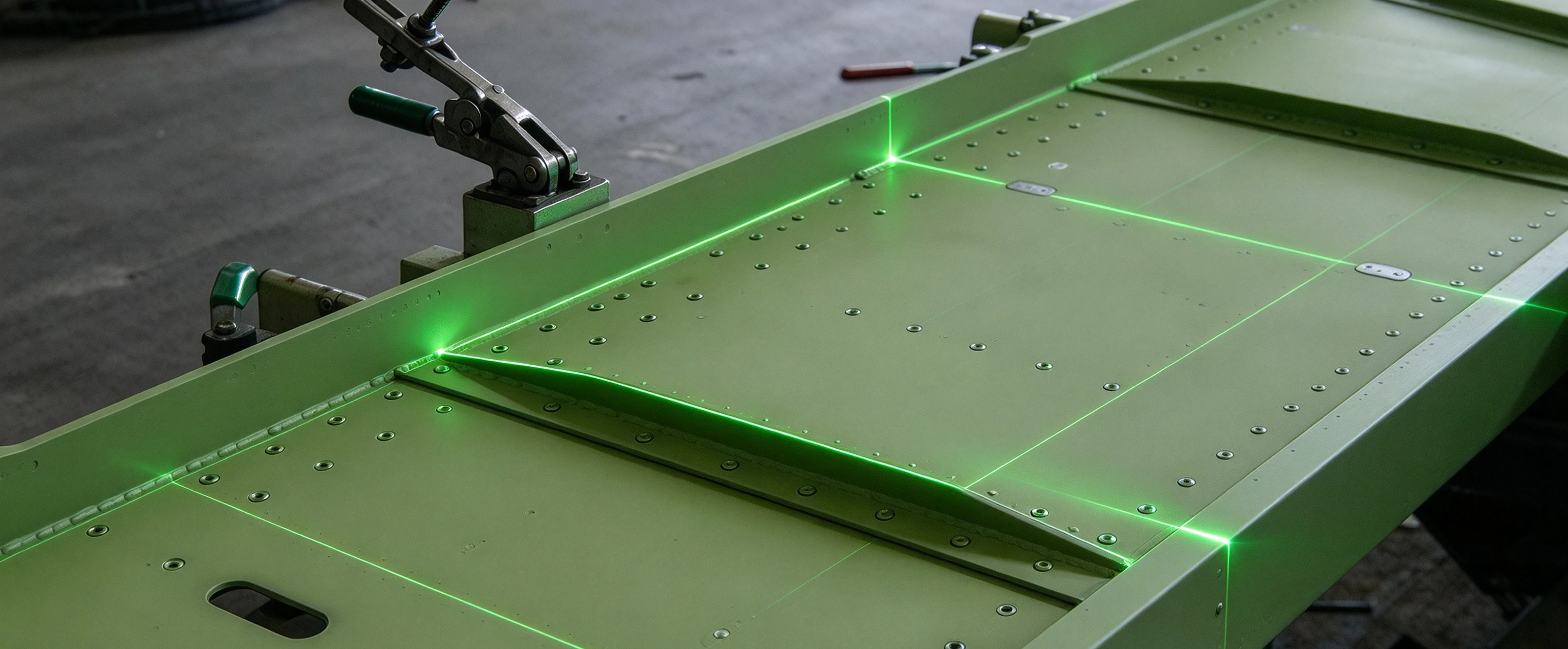
Practical Case: After a CRRC host plant in southern China introduced the 3D laser projection system, the preparation time for bogie frame assembly stations was reduced from 40 minutes with 2 workers to 10 minutes with 1 worker, achieving a 75% efficiency improvement per station. First-pass assembly qualification rate increased from 93% to over 99.5%, and changeover time for mixed-model production was shortened from 30 minutes to 5 minutes. CRRC Dalian's digitalized frame welding production line project was also selected as a typical case in the Ministry of Industry and Information Technology's 2024 IoT-Empowered Industry Development program. After commissioning, cycle time was reduced by 50% and product defect rate decreased by 90%.
Car Body Underframe / Extra-Long Frame Welding Positioning
For scenarios involving the welding of hundreds of small structural components on high-speed train and metro underframes, as well as extra-long frames (12–15 meters) for engineering machinery, the laser projection positioning locations include:
● Installation positions of all equipment bay brackets, cable penetration seats, and pipe fixing seats on the underframe.
● Overlap boundary lines connecting the underframe with side walls and end walls.
● Installation outlines and weld seam trajectories for all reinforcement plates and stiffening ribs on the underframe.
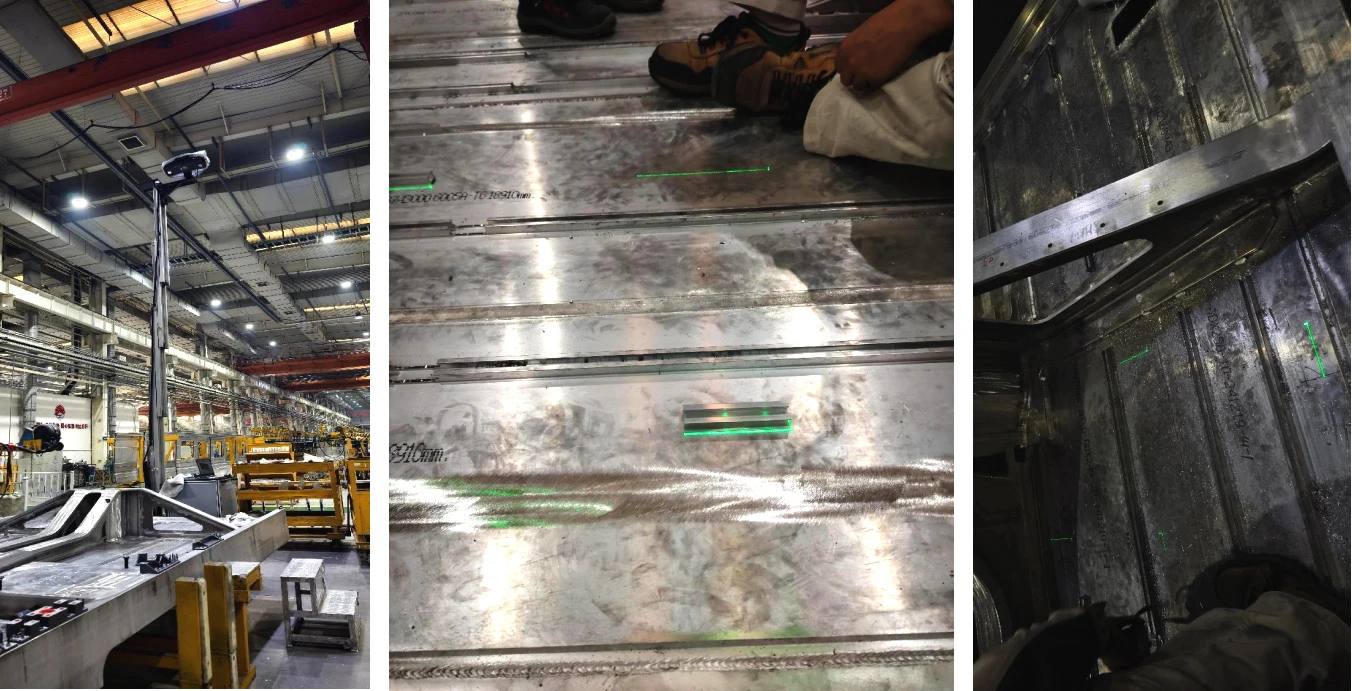
Installation positions of over 600 small structural components on heavy-duty frames (such as sensor brackets, pipe fittings, connection seats, etc.), all projected at 1:1 scale according to the CAD model onto the frame surface, enabling workers to complete positioning through "light-guided assembly."
After a heavy machinery enterprise introduced the Laser Projection system, the scribing and positioning time for a single 12-meter frame was compressed from 6 workers working 3 days to one-quarter of the original time. Human positioning errors were reduced by 95%, steel positioning templates were completely eliminated, and annual savings on template fabrication, storage, and maintenance costs exceeded one million RMB.
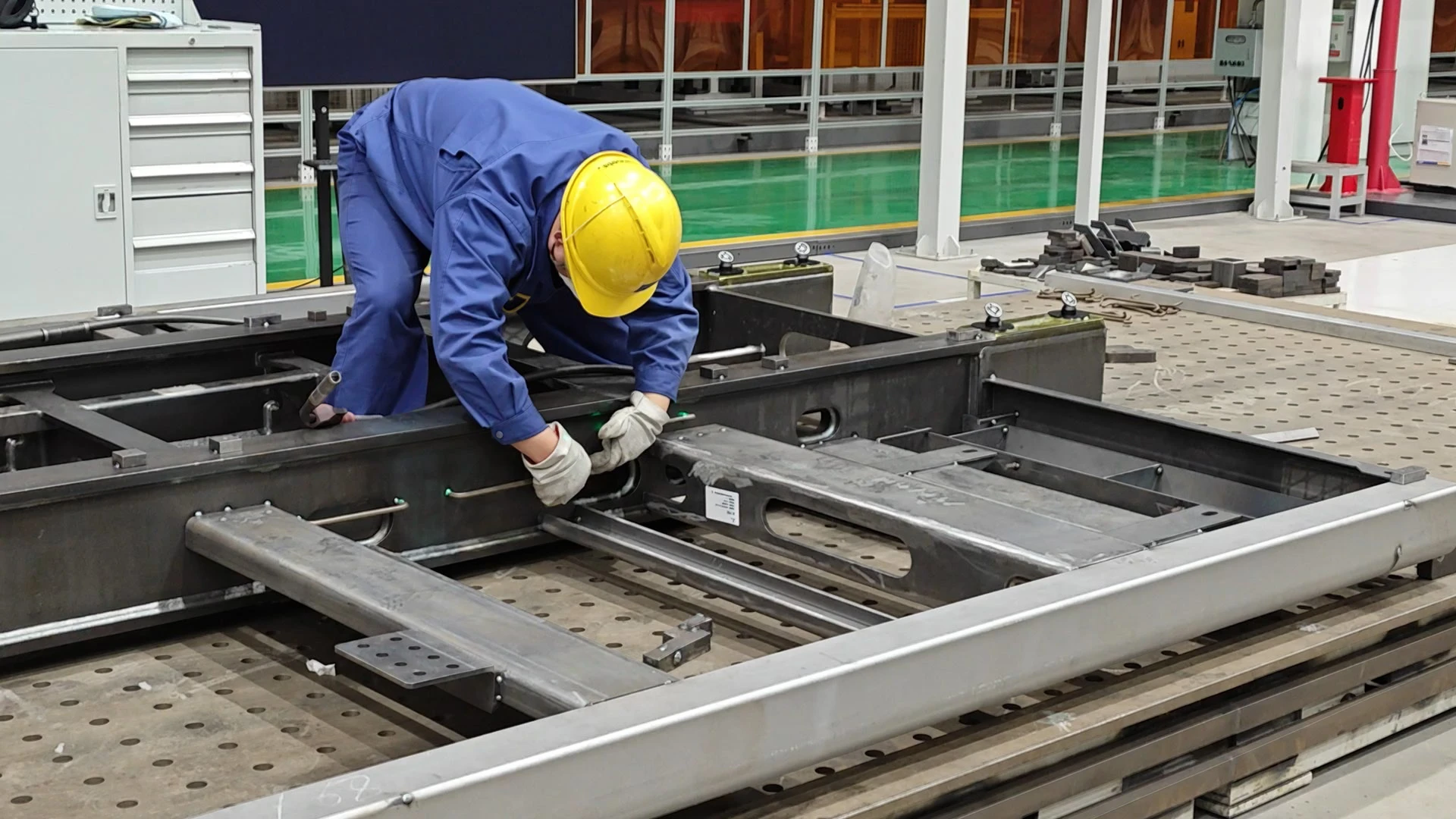
Vehicle Body Painting and Masking Positioning
Rail transit vehicle bodies typically feature complex corporate logos and multi-color livery schemes. The laser projection positioning locations include:
● Complete outlines of corporate logos.
● Boundary lines between different paint colors and positions of decorative lines.
● Masking boundary lines for windows and doors.
Once projected directly onto the vehicle body surface, workers can apply masking tape according to the laser lines without the need for physical templates. Layout time is reduced from the original 2–3 shifts (16–24 hours) to approximately 4 hours. When design changes are required, only a new CAD file needs to be loaded, and projection content can be switched in minutes — reducing response time from weeks to minutes.
Maintenance and Overhaul Positioning
Laser projection also has mature applications in rail vehicle maintenance scenarios:
The FXD locomotive car-body-lowering positioning device developed by the Chengdu Locomotive Depot projects horizontal and vertical laser lines on the service bogie to assist in the precise alignment between the car body and the bogie. This enables single-pass positioning without the need to repeatedly start and stop the pit-type lifting jacks for adjustment, improving operational efficiency while eliminating the safety risk of personnel entering underneath the vehicle for adjustments.
Post-welding quality inspection: The original weld seam trajectories are re-projected onto the completed welded workpiece. Any issues such as weld deviation, insufficient length, or missed welds become immediately visible to the naked eye, without the need for measuring instruments. This enables 100% full inspection with detection efficiency improved by over 300%.
Template-Free Vehicle Body Painting and Masking
Rail transit vehicle bodies typically feature complex livery schemes and corporate logo designs. Previously, positioning these masking lines required up to 2 to 3 shifts and carried a high risk of damaging the vehicle body. Now, with the 3D laser projection system, 3D virtual outlines of complex color schemes and paint units can be projected directly onto the vehicle body surface, reducing layout time to approximately 4 hours.
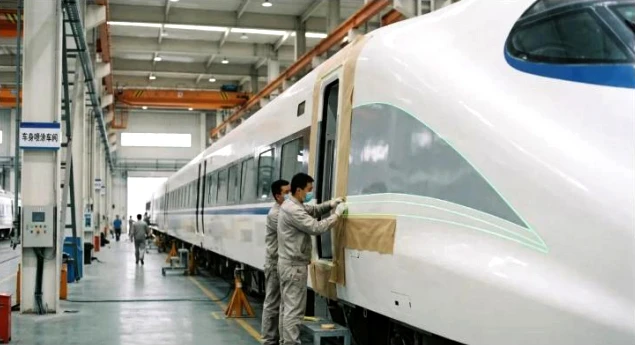
More importantly, the turnaround time for responding to design changes has been shortened from "weeks" to "minutes" — simply load a new CAD file and projection can begin immediately.